
For the week ending December 6, 2024

Happy Dufault DayTM to those who observe

A lengthy grievance arbitration decision covers, in depth, the application of the duty to accommodate in the context of family status from a pair of employees who sought changes to their work schedule to attend to childcare responsibilities. The majority of the panel applied the test for prima facie discrimination from the Alberta Court of Appeal in UNA (without any additional qualifiers that the employer wanted to tack on) and found the grievors met their burden: there was no requirement for self-accommodation at this stage of the test and it was unnecessary to show the term or condition of employment results in a “serious” interference with a “substantial” parental duty. With respect to the duty to accommodate, the employer suggested the grievors’ children, all under the age of 11, could walk home from school and remain there unsupervised for a half hour or so until their parents got home from work. The employer also argued that the grievors couldn’t insist on perfect accommodation and didn’t really explore other options. The majority of the panel also noted that where employers don’t properly engage in the accommodation assessment, they will not be able to claim undue hardship. Ultimately, the majority issued a declaration that the employer discriminated against the grievors and failed to accommodate to the point of undue hardship. The grievors were each awarded $12,500 in general damages and the employer was ordered to provide an accommodated schedule for the grievors to address their childcare obligations: Epcor Utilities Inc. v International Brotherhood of Electrical Workers, Local No. 1007, 2024 CanLII 119276 (AB GAA)

The Alberta Court of King’s Bench grants an interim injunction restraining one of four former employees of the applicant from soliciting for a period of one year from the date of his resignation. After a previous application for an interim interim injunction against the employees was dismissed, the court now found that there was a strong prima facie case that the single employee might be a fiduciary (and the other two branches of the RJR test were made out) based on a more developed factual record. The case for injunctive relief against the other employees was dismissed largely on the basis that the restrictive covenants, as written, were not enforceable or that they were clearly not fiduciaries. The case also contains some interesting discussion about non-acceptance covenants and what how to determine whether an employee is a fiduciary: People Corporation v 2578649 Alberta Ltd. (Quinn Advisory Group), 2024 ABKB 711 (CanLII)

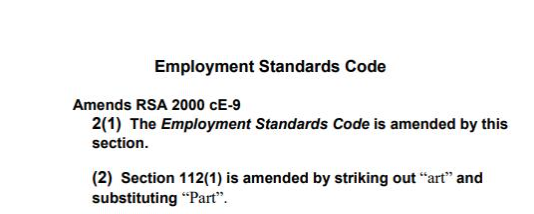
I missed this earlier, but Alberta’s Bill 36, the Miscellaneous Statutes Amendment Act, 2024, passed second reading on December 2, 2024, and will amend s. 112(1) of the Employment Standards Code:Proposed amendment to s. 112(1) of the Alberta Employment Standards Code.
Amy Salyzyn has an interesting article on Slaw.ca about the risks of generative AI in our courts: https://www.slaw.ca/2024/12/03/canadian-courts-and-generative-ai-broadening-our-gaze-to-potential-corrosive-risks/

The Supreme Court of Canada denied leave to appeal in KDM Constructors LP v International Union of Operating Engineers, Local 870. In response to an application for certification, KDM argued that the work being done was maintenance work and therefore fell outside of the definition of construction. KDM also argued that the construction registration system violated KDM’s right to free association under s. 2(d) of the Charter. The Board, the Court of Queen’s Bench (unreported), and the Court of Appeal all dismissed KDM’s arguments finding the corporation, KDM, did not have a right to free association.

Vice-Chair Nekolaichuk considers the definition of “construction work site”, “work site”, and the obligations of prime contractors under Alberta’s Occupational Health and Safety Act in this appeal of stop work and compliance orders. The orders were issued after a worker died performing roofing work at the facility. Which party ultimately bore responsibility for health and safety depended on whether the site could be divided and different prime contractors could have responsibility for each area or if Chemtrade was the prime contractor for the entire site including where the worker died: Chemtrade Fort McMurray Limited Partnership v Occupational Health and Safety, 2024 ABOHSAB 22.

Posted in Uncategorized | Comments Off on For the week ending December 6, 2024

For the week ending November 29, 2024

Update to a bizarre story: The Red Deer judge who put a defence lawyer in jail after the two had a spat has offered an apology to the lawyer: https://edmontonjournal.com/news/crime/red-deer-lawyer-jailing-judge-apology

Perusing the new applications report published by the Alberta Labour Relations Board each Monday, as I always do, I noticed an application for an employee to redirect union dues for religious reasons (GE-09297-APP-00001). I don’t think I’ve ever seen an application like that under s. 29(2) of the Labour Relations Code on the new applications report before today.

Employees can be denied employment insurance benefits if they lose their employment due to misconduct. In this context, misconduct just means that the employee willfully/consciously/knowingly/deliberately committed a violation or omission related to an employment rule knowing it could lead to termination. When challenging a decision to deny benefits on this basis, many employees are surprised to learn that they cannot challenge the validity of the employment rule or policy and whether they were wrongfully dismissed or their human rights were violated is outside the mandate of the Social Security Tribunal. That was the situation for the appellant in this case who sought to challenge his denial of employment insurance benefits on the basis that he could not comply with his employer’s vaccination policy for religious reasons. His appeal was dismissed by the Social Security Tribunal – General Division and the Social Security Tribunal – Appeal Division denied him leave to appeal. The Federal Court dismissed his judicial review application in large part because he didn’t raise Charter issues at the SST level and his arguments were aimed at the validity of the employer’s policy rather than whether what he did constituted misconduct: Sturgeon v. Canada (Attorney General), 2024 FC 1888 (CanLII)

Sofina Foods Inc. is facing 26 charges under the Occupational Health and Safety Act after one of its workers was trapped in a smokehouse and burned to death https://www.cbc.ca/news/canada/edmonton/sofina-food-worker-death-1.7392464

A recent Occupational Health and Safety Appeal Board decision serves as a good example of the standard of review applicable to OHS Officer’s and investigations into Disciplinary Action Complaints (“DAC”). Here, a temporary foreign worker in a supervisory role at Tim Horton’s was terminated two weeks after his arrival in Canada. Prior to his dismissal, he expressed concerns about how gross it was to clean the bathroom at the restaurant. The employee filed a CAC after his termination which was dismissed by the OHS Officer following investigation. The Officer found that the occurred during his probationary period and was due to unsatisfactory performance and therefore dismissed the DAC. The employee appealed and, on preliminary review, the Appeal Body upheld the dismissal. The decision of the Officer is afforded significant deference and reviewed on the standard of reasonableness. The Appeal Body emphasized that it is not the role of the OHS Officer to assess whether the employer had just cause for termination and that mere disagreement with the Officer’s decision is not grounds for appeal. The decision of the Officer was reasonable: Cardozo v 1831169 Alberta Ltd. operating as Tim Hortons, 2024 ABOHSAB 20 (CanLII)

An important read from Dr. Gideon Christian highlighting some troubling issues with the race and the Law Society of Alberta’s hearing of the complaint against Kelechi Madu, KC: https://www.slaw.ca/2024/11/28/the-law-society-of-alberta-trial-of-minister-madu-what-has-race-got-to-do-with-it/

Canada Post has started laying off some employees out on strike. Canada Post says business conditions have changed and the terms of the most recent collective agreement do not apply. CUPW says it’s just a scare tactic and the Canada Labour Code prohibits employers from terminating employees who participate in a lawful strike: https://www.thestar.com/business/canada-post-confirms-it-is-laying-off-striking-workers-union-accuses-management-of-scare-tactic/article_0ff6ffc8-adab-11ef-baa7-cfd8753fd127.html

Some guy wrote about Alberta’s Bill 33 and Bill 34 recently.

Roxanne Davis wrote about the pros and cons of private arbitration to settle employment disputes.

Posted in Uncategorized | Tagged , , , | Comments Off on For the week ending November 29, 2024

For the week ending November 22, 2024

My third favourite Christmas movie, Home Alone, premiered in theatres 34 years ago this week. Canonically, Kevin McCallister would be 42 years old now…

As part of a constructive dismissal claim, the plaintiff argued the employer was guilty of negligent investigation. Attempting to distinguish the an earlier ONCA decision that declined to extend the tort to investigations of employees conducted by employers, the plaintiff tried to argue that the investigators in this case were acting in the capacity of peace officers rather than as employer. The court didn’t buy that argument and struck this (and other) parts of the claim: M.P. v. Ontario Power Generation Inc., 2024 ONSC 6295 (CanLII)

The Sobeys case overturning Mia Norrie’s decision to accept the union’s final offer on wages over the employer’s offer (mentioned in this blog on October 25, 2024) is under appeal by the union: Civil Notice of Appeal, filed November 8, 2024.

The Canadian Judicial Counsel released its “Guidelines for the Use of Artificial Intelligence in Canadian Courts” back in September. Slaw has an interesting article evaluating the Guidelines and what can be done to improve them.

The plaintiff was laid off from his job and filed an unsuccessful duty of fair representation complaint with the Ontario Labour Relations Board against his union for declining to grieve his dismissal. Rather than seeking judicial review of the decision to dismiss his complaint, the plaintiff filed a lawsuit against the union alleging a host of causes of action (discrimination on the basis of disability, wrongful dismissal, defamation of character/slander, unfair representation, coercion, breach of contract, conspiracy to commit a crime against a union member). The union applied to have the case dismissed for lack of jurisdiction. The court agreed finding that adding a bunch of other causes of action like defamation, coercion, and conspiracy did not change the essential character of the claim and take it outside the exclusive jurisdiction of the OLRB which had already ruled on his issues: Kolacz v. Labourers International Union of North America Local 837, 2024 ONSC 6391 (CanLII)

Via CanLII, Joel John Badali has an interesting article in the Manitoba Law Journal discussing the inconsistent determination of jurisdiction for employment law issues in First Nations communities: Two Too Many Solitudes: Frist Nations Employment Law and the Unintended Effects of Wilson on Indigenous Employers

From the Department of I Can’t Believe I Actually Have To Say This, But I’m Going To Say It: Commissioner Sherry confirms that you can’t use materials created for the Alberta human rights tribunal dispute resolution (TDR) process, which is very clearly intended to be a without prejudice process, in other proceedings: Moen v Ridgeview Developments Ltd, 2024 AHRC 138 (CanLII)

In another interim decision concerning pre-hearing disclosure, Chief Oviatt reviews the law regarding disclosure of medical records and the careful balancing of fairness and privacy that it entails and ultimately orders the disclosure of unredacted copies of the complainant’s previously disclosed medical records (along with a host of other records): Elliott v Imperial Oil Limited, 2024 AHRC 137 (CanLII)

The Alberta Human Rights Tribunal dismisses a complaint in which a former employee argued her disability was a factor in her termination. Member Oshionebo holds that the termination was a result of a workforce reduction strategy after the employer lost one of its biggest clients and reminds us that the mere fact that an employer knew of an employee’s disability at the time of termination of employment is not enough to infer that the disability was a factor in the employer’s decision to terminate the employee: Reyburn v Federated Co-Operatives Limited, 2024 AHRC 134 (CanLII)

A complainant sought judicial review of a decision of the Chief of the Human Rights Tribunal upholding the Director’s decision to dismiss the complaint. Justice Johnston determined that the standard of review of such decisions (under s. 26 of the Alberta Human Rights Act) is reasonableness. Justice Johnston then walked through the Chief’s decision and found it was based on reasoning that is both rational and logical and dismissed the application for judicial review: X v Alberta Human Rights Commission, 2024 ABKB 681 (CanLII)

In bizarre, non-employment law news, a lawyer in Red Deer was briefly jailed after getting into an argument with a judge about a witness subpoena during a criminal trial. After being released from holding, which the judge says the lawyer entered voluntarily, the lawyer left the courthouse and did not return to finish his matter. The incident happened on November 8 and the lawyer has been ordered to attend before the judge on November 22. Excerpts from the transcript are available in the Edmonton Journal article and additional context and commentary is available via Ian Runkle from Runkle of the Bailey. Read it and judge for yourself.

Via HRD, the Yukon government is looking to amend legislation to regulate social workers in the territory following a report by the CBC earlier in the week. The CBC story revealed that a social worker had been spreading QAnon conspiracy theories and was an ardent follower of the Queen of Canada.

Thanks to a conversation with a friend earlier today, it came to my attention that the plaintiff in Egan v. Harbour Air Seaplanes LLP, 2024 BCCA 222 (CanLII) is seeking leave to appeal to the Supreme Court of Canada. Recall that the British Columbia Court of Appeal found that this termination clause was sufficient to rebut the presumption of common law notice:

The Harbour Air group may terminate your employment at any time without cause so long as it provides appropriate notice and severance in accordance with the requirements of the Canada Labour Code.

Posted in Uncategorized | Comments Off on For the week ending November 22, 2024

For the week ending November 15, 2024

Thank you for your service. Lest we forget…

This one is not really employment-related, but it’s a good reminder to be careful when notarizing documents and be careful not to help further OPCA mumbo jumbo. After successfully appealing sanctions ordered by Justice Rooke, Justice Nixon imposed penalties following the conclusion of his process. Of note, one of the respondents in these matters got half the fine that Justice Rooke originally awarded and the other got the same amount: Akpan (Re), 2024 ABKB 651 (CanLII)

Normally, when the assets of a business are sold, the employees are constructively dismissed. Employment standards legislation contains provisions that deem employment to be continuous when the employees are retained by the purchaser such that their tenure with the vendor is recognized for the purpose of vacation entitlement and minimum termination notice. In this case, the exact closing date was a bit muddy and the Director of Employment Standards determined the closing date was five days before the employees were terminated by the vendor. As a result, the vendor was found liable for five days of unpaid wages plus termination pay for each employee. The issue here was whether the Director erred in that determination: Overstory Media Inc. (Re), 2024 BCEST 109 (CanLII)

The Alberta Human Rights Tribunal considers whether it can deal with an application to dismiss a complaint because it was filed outside the limitation period as a preliminary issue even if it was not addressed at the initial screening phase. Member Scott rules that the issue can be considered on a preliminary application, but ultimately finds that the complaint was timely: Onyschuk v City of Edmonton, 2024 AHRC 131 (CanLII)

Keeping with the human rights theme, no prima facie discrimination was found when the respondent refused to allow the complainant to do part-time, irregular work while off on maternity leave since the respondent treated all employees off on leave the same way: Trafford v ISCO Canada, Inc., 2024 AHRC 129 (CanLII)

In a hearing to assess damages against a defendant noted in default, the Alberta Court of Justice considered the impact of inducement (the plaintiff moved from Moncton to Westlock to take the job) on damages for wrongful dismissal and ordered “bad faith” damages for the manner of dismissal (in an amount that exceeded what the plaintiff requested) because the defendant refused to pay the amounts invoiced by the plaintiff and seemed to lead her on causing extreme anxiety: Rosenberg v Northern Nursing Solutions Inc., 2024 ABCJ 220 (CanLII)

The Alberta Court of King’s Bench dismissed an appeal against conviction and sentence under the Occupational Health and Safety Act related to the death of an employee of Inland Machine Services in 2019. The court found the trial judge properly applied the principles from the Court of Appeal decision in Precision Diversified Oilfield Services Corp to the general duty charge and the assessment of the due diligence defence. The Court also found that the sentencing judge was owed a great deal of deference and the conditions that existed at the time of sentencing, namely the lack of insight into the company’s role in the worker’s death, continued into the appeal: R v Inland Machining Services, 2024 ABKB 664 (CanLII)

The Alberta Court of King’s Bench dismisses an application for judicial review challenging a decision of the Board of Trustees of the Red Deer Separate School Division imposing sanctions on a Trustee for violation of the Education Act and the Board’s policies. The Trustee in question said the Holy Spirit told her to “go for it” and post a meme comparing LGBTQ pride to Nazi Germany. It’s not every day you see the Court faced with deciding whether meme posting contravenes Roman Catholic values: LaGrange v Red Deer Catholic Separate School Division, 2024 ABKB 665 (CanLII)

Some guy wrote about the ongoing Canada Post labour situation on Thursday: https://carbertwaite.com/news-legal-commentary/breaking-down-canada-posts-imminent-strike/

That guy was wrong about a rotating strike, though. A nationwide strike began just after midnight on the morning of November 15: https://calgary.ctvnews.ca/canada-post-workers-go-on-strike-friday-morning-disrupting-deliveries-1.7111281

Here’s a statement from CUPW on the strike: https://www.cupw.ca/en/statement-canadian-union-postal-workers-more-55000-postal-workers-strike

Here’s a statement from Canada Post in response to the strike: https://www.canadapost-postescanada.ca/cpc/en/our-company/news-and-media/corporate-news/negotiations/2024-11-15-cupw-announces-national-strike-that-will-cause-service-delays-for-canadians

And here’s what Labour Minister Steven MacKinnon had to say over on Twitter (I’m not calling it X, ever): https://x.com/stevenmackinnon/status/1857253622121198045

The Federal Court dismissed a mass tort claim brought by 330 members of the Canadian Armed Forces alleging a directive issued by the armed forces requiring members to be vaccinated against COVID-19 violated their Charter rights. In July 2023, a non-binding decision of the Military Grievances External Review Committee found the directive did violate the Charter rights of some members. Here, however, the Court found the pleading failed to disclose a reasonable cause of action: Qualizza v. Canada, 2024 FC 1801 (CanLII)

Posted in Uncategorized | Comments Off on For the week ending November 15, 2024

For the week ending November 8, 2024

The world didn’t end this week, but I guess it’s still early…

The Ontario Court of Appeal finds the clear, broad terms of the minutes of settlement and release extinguish the rights of the plaintiff to payment for stock units that vested and became redeemable at the time of his termination: Preston v. Cervus Equipment Corporation, 2024 ONCA 804

The Alberta Court of Justice holds that an confidentiality and non-competition agreement signed by a company and an independent contractor is subject to the same level of scrutiny as if it were signed by an employee and finds that the contract is unenforceable for being too vague and ambiguous in its terms: NL Fisher Supervision & Engineering Ltd. v Boettger, 2024 ABCJ 225

The Alberta Court of Appeal upholds an appeal of a judicial review challenging a decision of the Alberta Human Rights Commissioner to uphold the decision of the Director to dismiss two human rights complaints resulting in the dismissal of the second of two complaints. That description was more confusing than necessary, but the helpful nugget is the Court’s review of its approach to judicial review of the Director’s decision to dismiss a complaint: Shodunke v Alberta (Human Rights Commission), 2024 ABCA 348

The Appeal Body was determining an appeal by an employer that it had to pay to an employee termination pay and vacation pay as well as the usual order of officer fee. The employee claimed he was terminated (despite writing on the complaint form “I still work there”). The employer said he resigned. The Appeal Body said there was no termination and the employer did not meet the onus to prove the employee resigned so… the employee is still employed (even though he has new employment and hasn’t had any shifts with the employer since before the complaint was filed) and the order is revoked: Centreline Dental Lab Ltd. v Tymczyszyn, 2024 ABESAB 18

In British Columbia, the court considered a class proceeding by a class of plaintiffs who were duped into paying fees to a group of immigration consultants to get jobs with Mac’s Convenience Stores only arrive in Canada and find out the jobs were not available. Mac’s was found to be vicariously liable for the consultants’ breach of fiduciary duty to the plaintiffs. The court also held, on these particular facts, that the plaintiffs did not have a duty to mitigate their damages once it was apparent that the promised jobs were unavailable because to do so would require them to act unlawfully and risk enforcement action from CBSA (they were temporary foreign workers subject to a strict statutory regime allowing them to work in Canada at all). And these issues were all heard via summary trial(!): Basyal v. Mac’s Convenience Stores Inc., 2024 BCSC 2007

The British Columbia Supreme Court grants an application for an injunction brought by the purchaser of a dental clinic to prevent the vendors from opening or participating in a competing dental clinic post-sale: Dentalcorp Health Services Ltd. v Dr. J.S. Minhas Dental Corp., 2024 BCSC 2006

The Supreme Court of the Northwest Territories enters the chat with a wrongful dismissal case involving a 69 year old plaintiff in a senior management role working for the Town of Hay River for only 18 months. He was terminated in 2015 and by the time of trial still had not found new work. The court awarded an 8 month notice period: Harris v Town of Hay River, 2024 NWTSC 47

Arbitrator Sims decides that grievances brought against Telus’s return to work program where employees previously working from home had to report to the office three days a week and the requirement for employees affected by the Barrie office closure having to move within 150 km of Montreal (or accept a voluntary severance package) were barred by the terms of a previous agreement entered into during bargaining in 2011. Furthermore, promissory estoppel did not prevent Telus from making these decisions which were, in any event, reasonable exercises of its management rights and other flexibilities it negotiated for itself in the most recent collective agreement: Telus Communications Inc. v Telecommunications Workers Union, United Steelworkers Local Union 1944, 2024 CanLII 106321

Last week, Bill 24 was introduced into the Alberta legislature which purported to make a number of amendments to the Alberta Bill of Rights including giving individuals the right to refuse vaccination. This week, Bill 33 and Bill 34 have been introduced which update how public bodies will handle personal information and how public bodies respond to access to information requests by repealing the Freedom of Information and Protection of Privacy Act and replacing these statutes with, respectively, the Protection of Privacy Act and Access to Information Act. All of the changes in these three bills will only affect public bodies in Alberta and will not impact private sector employers.

Six employees and their unions challenged pre-placement and random alcohol and drug testing requirements imposed by the Canadian Nuclear Safety Commission. The challenge failed at first instance and the Federal Court of Appeal dismissed their appeal: Power Workers’ Union v. Canada (Attorney General), 2024 FCA 182 (CanLII)

A Canada Post supervisor grieved his termination after management discovered he was involved in a long-term intimate relationship with a direct report contrary to the employer’s conflict of interest policy. Though the grievor was remorseful, he did not disclose the relationship in accordance with the policy (management found out after the grievor confessed to his superintendent because he was upset rumors of him having a relationship with another employee was negatively affecting his undisclosed relationship) and the termination was upheld: Canada Post Corporation v Association of Postal Officials of Canada, 2024 CanLII 108264 (CA LA)

Posted in Uncategorized | Leave a comment

For the week ending November 1, 2024

Bit of a slow week, I guess?

The Alberta legislature is back in session and the first bill tabled amends the Alberta Bill of Rights to give individuals with capacity the right to refuse vaccines or other medical treatment. Vaccine mandates for employers subject to the Alberta Bill of Rights may be a thing of the past: Bill 24 Alberta Bill of Rights Amendment Act, 2024

The Canadian Medical Association is urging government to prohibit sick notes for short-term absences to help take some stress off of the health care system: https://www.cma.ca/about-us/what-we-do/press-room/cma-calls-elimination-workplace-sick-notes-create-more-health-care-capacity

A seasonal worker at a golf course was terminated one month into his term of employment and awarded a five month notice period (effectively to the end of the golf season): Smith v Lyndebrook Golf Inc., 2024 CanLII 103671 (ON SCSM)

The Court finds a 7 year non-competition period in an agreement signed as part of a share purchase agreement is unenforceable because it is too long: ARC Surveys Ltd v Ni, 2024 ABKB 629 (CanLII)

Nice article on Human Resources Director featuring commentary from Ronald Minken and Tanya Sambi summarizing legal issues that may result from employees recording termination meetings: https://www.hcamag.com/ca/specialization/employment-law/caught-on-camera-navigating-new-trend-of-recording-termination-meetings/512117

An arbitrator in Ontario dismissed the union’s position that the employer violated the employee’s human rights by implementing a COVID-19 policy and requiring the employee to undergo rapid antigen testing. The arbitrator found the policy did not discriminate the employee on the basis of creed as the employee’s concerns that testing would alter her DNA were not supported or linked to a shared belief of a community or organization: Oxford (County) v Canadian Union of Public Employees, Local 1146, 2024 CanLII 105213 (ON LA)

Posted in Uncategorized | Leave a comment

For the week ending October 25, 2024

Here are some things that caught my attention this week…

Justice Elson strikes a claim against one of three defendants in a wrongful dismissal action finding no basis for standalone claims for “bad faith conduct” and “negligent investigation”: Hollinger v SaskTel Centre, 2024 SKKB 178 (CanLII)

Vice-Chair Schick granted an employer’s application to dismiss an OHS appeal on the grounds it was filed out of time. The appellant, apparently, thought the deadline to file the appeal fell on a long weekend and could therefore file and serve on the next day the ALRB office was open, but the deadline actually fell on the Friday immediately before the start of the weekend thus highlighting the importance of correctly calculating your appeal periods: Thorkelson v Shell Canada Limited, 2024 ABOHSAB 17 (CanLII)

Justice Poleman quashes the decision in an interest arbitration because the arbitrator relied on comparators outside of the employer’s competitive climate and cast doubt on the employer’s wage data based on facts not supported in evidence. Citing Vavilov, the decision was found to be unreasonable for lacking transparency on material points: Sobeys Capital Incorporated v United Food and Commercial Workers, Local No 401, 2024 ABKB 614 (CanLII)

A long-term employee was terminated after an investigation into alleged sexual misconduct found that he sexually harassed a subordinate employee. An adjudicator found that he had been unjustly dismissed finding that the relationship between the two was personal and consensual and substituted a four month suspension in place of the termination. The Federal Court upheld the adjudicator’s decision on judicial review. The Federal Court of Appeal, however, allowed the appeal for a number of reasons including the fact that whether or not sexual conduct and words are welcome or tolerated can vary over time and with their content despite a personal and consensual relationship: Canadian Pacific Railway Company v. Sauvé, 2024 FCA 171 (CanLII)

In two separate applications for revocation filed by employers, the Alberta Labour Relations Board considered the meaning of “other relevant matter” in s. 54(1) of the Code. In both cases, the employer applied to revoke the bargaining rights of the union because the bargaining unit in question had no members for more than three years. The Board dismissed the argument in one case that an “other relevant matter” that would warrant dismissal of the revocation application is the possibility that the employer might in the future start employing scaffolders that would be members of the bargaining instead of contracting out for those workers. In another, the union argued that speculation the employer had been in discussions with another union about representing its employees on an “all employee” basis is an “other relevant matter” that would warrant dismissal of the application. The Board disagreed. In both cases, the Board found that if the statutory prerequisites were met, revocation was presumed to result subject to some residual discretion maintained by the Board. However, the Board would not exercise that discretion based on the kind of speculation alleged by the unions on these facts: United Brotherhood of Carpenters and Joiners of America, Local Union No. 1325 v Clearstream Energy Services LP, 2024 ALRB 89 (CanLII) and International Union of Operating Engineers, Local Union No. 955 v PCL Industrial Constructors Inc., 2024 ALRB 103 (CanLII)

The ALRB denied the employer’s request to depart from the usual 30/30 rule and allow 8 employees to vote who were hired after the date the application for certification was filed: General Teamsters, Local Union No. 362 v Bluewater Group Limited, 2024 ALRB 106 (CanLII)

The ALRB ordered the union file a grievance and that the matter proceed immediately to Step III in the grievance procedure as a remedy for a breach of the union’s duty of fair representation (in one of the very rare cases where the Board actually found a union breached that duty): Waitson v International Brotherhood of Electrical Workers, Local Union 424, 2024 ALRB 111 (CanLII)

Posted in Uncategorized | Leave a comment